
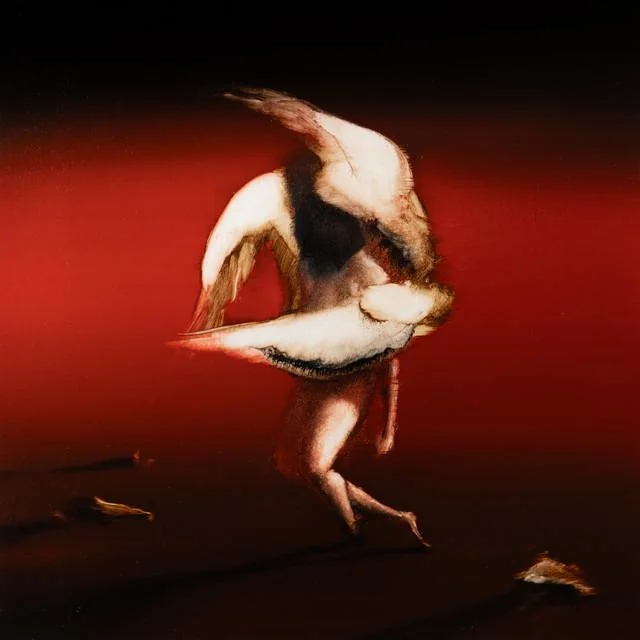
Pain to Power
Maruja
This album is beautiful; it is passionate, it is heavy, it is earnest. I have waited a long time for Pain to Power. Over the last few years of monumental EP after monumental EP, the hype for this eventual full album debut grew inexorably within. With every single released in the rollout, my excitement exploded evermore. No song electrified my teeming anticipation more than “They Look Down On Us,” a gargantuan ten minute epic of a track that fills me with such swells of emotion, it feels as if I cannot help but be swept up by a massive, and growing, wave of frenetic, revolutionary fervor.
Maruja have an incredible knack for imbuing their music with a deep, compelling call to arms. In the case of “They Look Down On Us,” this call is abundantly clear lyrically, what with its emphasis on the brutality of late-stage capitalism and the importance of communal power, but this call is just as vibrant instrumentally. The first half of the track can best be described as a withering storm: the second half, lachrymose catharsis. In this way, Maruja whip up the listener into a righteous fury, and then provide a productive path to redirect that energy towards. It is, all at once, mournful, optimistic, pained, joyful, passionate, and committed to the central cause they put forward: the cause of the people, by the people, for the people, to secure the future of the people. It is a truly invigorating song, to say the least.
Fortunately, as I sit here on release day, several spins in, I can confidently say that the same gravitas that made the singles so special is also present on the rest of the tracklist. In fact, the singles themselves are even better in the full context of the album as a single narrative project. Maruja have really crafted an instant classic, straight from their souls to ours.
Sometimes, an album simply “has it,” where “it” is an intangible, but obvious spiritedness. These are the records that I find best exemplify my rich love for the album itself as a medium. They are the albums that sincerely have something to say, and the talent to say it. Maruja’s Pain to Power undeniably has it. This was to be suspected after one of the best single rollouts I have ever had the pleasure to witness, but it is welcomingly confirmed now that we have the ability to assess their long-awaited creative offering in its totality.
One aspect of Pain to Power that I particularly enjoy is the crushing moments Maruja frequently graces us with. Prominently, this is first seen in the first moments of the first song, “Bloodsport.” Other memorable moments include towards the end of “Born to Die” (7:30 – 8:35), the end of “Break the Tension” (3:10 – end), and the eruptive chorus of “Trenches.” These veritable explosions of noise serve not as bludgeoning blows, but as mustering moments of urgency. Without fail, they make the hair on my nape stand at attention and my mind’s slate wipe clean, totally refocused on what I am listening to. When these moments occur at the end of a patiently frenzied buildup of energetic tension, as they do frequently, this effect is only all the more heightened.
To continue on the topic of masterful buildups, I cannot express enough how pleased I was to discover two more lengthy tracks in addition to the single “They Look Down On Us” (“Born to Die” and “Reconcile” specifically). All three tracks are just about ten minutes, and all three tracks serve key roles in the flow of the album. They all have clearly distinct inflection points that give each one its own unique journey. The placement of these three within the tracklist serves to further amplify their respective effects on the album’s tempo.
Beginning with the first of the three, “Look Down On Us” establishes a flavor palette for the remainder of the album: politically, lyrically, emotionally, and compositionally. Furthermore, it opens with an aggression that perfectly carries the momentum of the volatile opener “Bloodsport,” and ends in a beautifully soaring fashion that seamlessly segues into the most tender cut on the album: “Saoirse.”
This then leads into the second lengthy track, “Born to Die,” which slowly, purposefully opens with a pair of verses that aim to inquisitively identify and name the societal restrictions which we labor under:
This culture wanna limit us
And capitalise our output
Limit our potential
I know what this life is worth
We are universal spirits
And our kingdom is this earth
All those years of holding back
It’s only you you do not serve
Mindful of our differences
Respect wants holding down
Most already know this
But they’re afraid to make a sound
So herein lies the problem with the many and not the few
Always passing out the blame instead of honesty and truth
This life is temporary, why you holding onto youth?
Possessions weigh you down, you can’t let go of what is new
Communication inspires hope, humility controls your pride
Thеre’s no need to wear disguises
Our spеcies overcomes through perseverance in the mind
Our dreams are a reminder this realm ain’t the only kind
This realm ain’t what you define, no answers, running blind
Like a dog caught in the headlights of a truck that’s passing by
Care less about what survives, only got ourselves in mind
Ain’t it terribly ironic how we’re all just born to die?
From this initial portion, the song embarks on a steadfast instrumental incline that eventually culminates in a gorgeously cathartic cascade. From here, Maruja maintains the energy with two of the most blistering tracks on the album: “Break the Tension” and “Trenches.” The meditative instrumentals of “Zaytoun” then serve as a bridge to the third monster track, and the closer, “Reconcile.” Following the trend in the previous two tracks (of high energy to low, or vice-versa, such that they compliment the directly surrounding songs), Reconcile matches “Zaytoun” by starting with a complimentarily gentle introduction that proceeds to slowly grow into a forceful close that brilliantly transitions back into the turbulent opener.
“Reconcile” also, importantly, acts as an ultimate, cathartic release of the tension that Maruja steadily builds throughout Pain to Power. It does so by resolutely remaining focused on the crucial necessity for love. Maruja incorporate a lot of pain on this album, but all with the goal of inspiring the shifts that are needed, small and large, to rectify all this trauma that plagues us as it begets only further suffering. There is much societal healing that must happen, and it will only happen if we fight with love in our hearts and minds: if we show sympathy in our words, our actions, and our desires. This is not easy; there is no switch to flip. It requires changing minds and inspiring spirits. It must overcome fear, and find strength in community. This is why the outro enthrallingly consists of two simple directives that Maruja ardently bestows upon us: “Have no fear” and “Pray for love.”
Ultimately, Maruja is a band with an agenda. Their music is crafted to help, in what way they can, move us all closer to a place beyond the suffering of the present, beyond the current crisis of rife apathy. In this noble aim, I think they are one of the most successful bands out there now. Music is a powerful force, and Maruja is very much aware of their capacity to harness it. They say as much on “Reconcile,” in one of my of favorite moments on the album:
Music lifts our spirit and love uplifts our souls
Ancient language healing, so let the music take control
Maruja’s committed understanding of the role they wish to play as a band is also born out of the very progression of the band itself. Through its many years together, Maruja’s music has become much more political, forceful, and purposeful as they have themselves lived through the changing world and subsequent multitude of emergent crises. Now, as a band fully realized, ideologically and musically, Maruja officially storm onto the scene with a deafening thunder.
Favorite Song: They Look Down On Us
Leave a Reply