
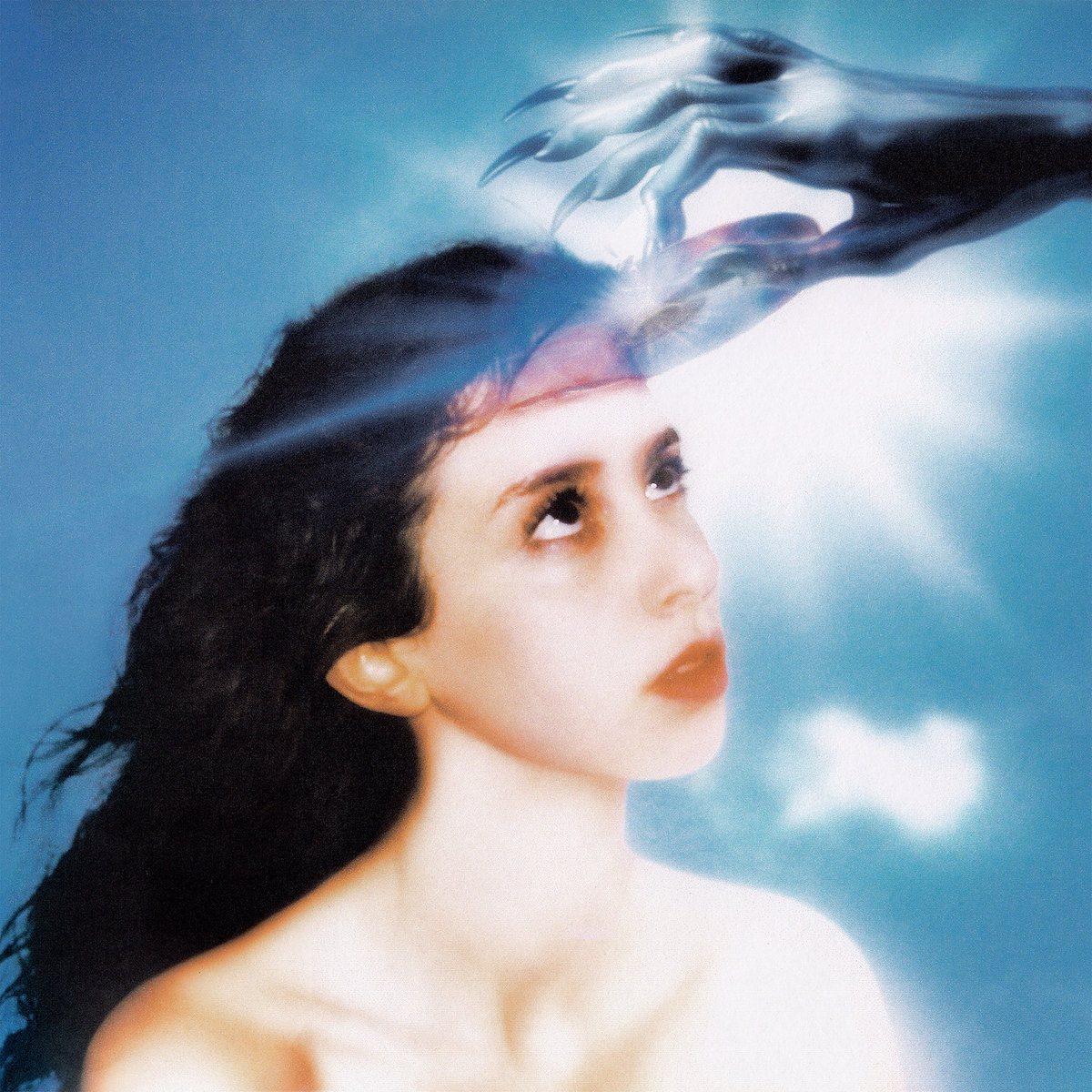
Imaginal Disk
Magdalena Bay
This is an album of beautiful and soaring moments of ecstasy. So much to hone in on, so much to close your eyes and float on clouds to, so much to just smile and softly bop your head along with. Mica Tenenbaum and Matthew Lewin really deliver here on their sophomore lp as they construct a dazzling world that is just a joy to get lost in. It is always special when an album captures me so immediately and with such urgency upon release. I had already been obsessed with the singles—especially the delightfully labyrinthine “Tunnel Vision,” a song defined by a carefully measured buildup to a rapturously raucous release. But even having already heard the song many times, it hit even better in the context of the overall album. And the same can be said for every song as each one lifts each other up through their shared contribution to the overall entrancing mystique that the album washes itself in. The general elements of psychedelic meandering that permeate the album give a sense of drifting through a vast space. A space that feels as infinite in its journeyable lengths as it does paradoxically apt for highlighting the most compelling moments on the record, which almost seem to briefly materialize like brilliantly ephemeral celestial objects.
As much as the album feels to me to be inherently about a wondrous, serpentine journey through a constantly evolving soundscape of varying complexity and sensations, it is also about just fucking dancing. It is a trippy record for sure, one that is simply an absolute joy to lie down in bed and listen to on headphones, but it is just as much a record to get down to and groove. Whether the chorus on “Death & Romance,” the bridge in “Fear, Sex,” or the chorus in “The Ballad of Matt & Mica,” particularly: “Killing time every day/ Bang-bang, never ending.” Ugh. I also love moments like the start of “Vampire in the Corner” that compel me to walk around, holding my headphones, eyes closed, and swaying gently. And I just adore the moments of rapturous cataclysm like the instrumental breakdown in “Tunnel Vision” or the last third of “Killing Time,” where we get this vocal switch up as Mica offers a harrowing view of accelerating time:
I’m looking in the mirror and swallowing the key
It only takes a minute to forget a week
Count up all the years that we spend asleep
If time is meant for living, why’s it killing me?
It gives me chills in a manner that is as ethereally enchanting as it is hauntingly expressive. With the way the song feels like it is being stretched to the point of breaking during this part, it really succeeds at hitting you with the petrifying magnitude of time and irrelevance we occupy in its passing. It only takes a minute to forget a week. One blink and years have passed.
Now this album is quite good at pulling you into another world, but it also excels at letting you build that world yourself. From the very start of the album, Mica primarily sculpts specific scenes and images with lyrics that have meaning to her, but are ambiguous enough to have completely different meaning for the listener. Mica expounded on this during a reddit AMA on r/indieheads:
The lyrics mean something specific to me, but intentionally things are left a little open ended because it’s cool when people can draw their own interpretation and meaning from the words. I mean sometimes the intention of the lyrics is more concrete/straightforward but other times they really are a sort of subconscious flow and dreamlike. And it’s not until later that I figure out what they mean (to me), and that’s always a cool process of discovery. Maybe it’s the same for our listeners?
For me at least, I can confirm it is the same. My first listen to Imaginal Disk did not present me with a clear defined meaning or story. Instrumentally, I was enraptured by the rich variety of sounds that they managed to consistently deliver in tracks that were as cohesive as they were unique. Lyrically, I mostly got general elements of love, self-conflict, and evolution. As I have continued to listen to Imaginal Disk, my thinking on the album has changed. Both from the knowledge of new context in terms of the album’s lore, but also as I have considered the songs more and what I take from them. And it has been a cool process of discovery as I have naturally honed in on several songs as particularly meaningful in a way entirely separate from the album. Songs like “Cry for Me” are both sonically mesmerizing and lyrically open ended enough to make fitting frames for the listener’s own experiences. At the same time, as Mica said, they do employ more concrete/straightforward lyrics as well, such as on “Image.” The breadth of this spectrum of narrative overtness is exemplified in the first three songs: “She Looked Like Me!,” “Killing Time,” and “True Blue Interlude.”
Starting with the opener, “She Looked Like Me!” starts off with a low whirring and then a quick, ghostly “Hello” before we get a beat decorated with bizarre background sounds of distorted cheers, hoots, and chattering? Exactly what you are listening to is difficult to place, but its Carrollesque nature perfectly frames Mica’s floating vocals. You can close your eyes and imagine her words animated as creeping aural tendrils lazily reaching out to form the edges of an invisible frame, all while carrying with them a hazy picture slowly coming into focus:
Down the line, over the waves
Two kids and a military
Turn their tongue, change their name
La love, born to marry
Crossed their hearts, crossing the earth
One year, then a baby’s carried
Grows up young, screams at graves
Bang-bang and it’s customary
Ordinary
The way Mica just waits a beat between “customary” and “ordinary” really emphasizes the latter in a way that seems to highlight the ethereal magic that can exist just as much in the ordinary as the fantastic. Which ties into what I see as the story of two young lovers leaving their home to look for something better. They change names, learn a new language, marry, have a kid, and live a customary life. An ordinary life. A life that has been lived countless times before and will be lived in the future. But maybe also one of hardship or even death considering the ominous line “Grows up young, screams at graves.” It is also worthwhile to note that this passage is also likely referring in some part to Mica’s family herself since she is originally from Argentina and moved to Miami with her parents when she was 1.
The track truly hits its climactic crescendo during the third verse when Mica gets into this cryptic description of meeting an alternate version of herself: “I didn’t know her when she walked in/ But I recognized her eyes.” The depiction is intensely dreamlike and clearly loaded with personal meaning in a way that is quite intimate and powerful. The verse then violently explodes when Mica describes how this other version of her “…shot at me like an earthbound bullet/ And then she wrapped her hands around my neck and I felt love.” And specifically that last half of the second line is one of the best deliveries of any line on the whole album as everything seems to melt away on the word “love” in what can only be described as an utterly intoxicating transition into the verse’s close:
Just ordinary love
Let me hold you in my arms
Oh, love, that old familiar drug
It simply gives me shivers, especially on that last line. But as gorgeous a moment it is, Magdalena Bay are giving us a forebodingly aggressive depiction of love here as it comes right off Mica being attacked by an alternate version of herself. Since the album focuses so heavily on self-improvement—often through fantastical, unreal means—this self-attack can be seen perhaps as a violent instantiation of self-denigration born from an unhealthy obsession with perfectionism. A toxic warping of self-love. In that same vein, this other Mica’s attack represents a personification of the inherently dystopian nature of the Imaginal Disk procedure itself, a recurring topic on the album that is more explicitly explored on the third and fourth tracks.
Going into the second track, “Killing Time,” we are greeted by what is ostensibly a refreshing respite from the unsettling nature of the opener. The opener ended on the theme of America stealing Mica’s fate and her being choked, albeit supposedly lovingly, by a mysterious doppelganger. In contrast, “Killing Time” begins with Mica singing about the passing of time in a general sense as she draws upon the age-old tactics of counting sheep and watching the clouds. Activities that are often looked at with, if not fondness, at least a lack of underlying menace. But Mica’s choice to focus on “killing time” specifically hints toward the more disconcerting evolution of the song. Whereas the initial lyrics dwell on lazily passing time lying on a grass hill looking at clouds in the sky or counting imaginary sheep in a comfy bed, it all melts away as the song progresses to a much more unsettling view of time as something to fear in its breakneck swallowing of any tangible sense of meaning. Years pass in a dreamlike haze and instead of killing time, time is killing Mica. And the implication is that she will continue to kill time and it will continue to kill her as long as she delays living the most idealized possible version of her life, a version that is unlockable through the Imaginal Disk procedure.
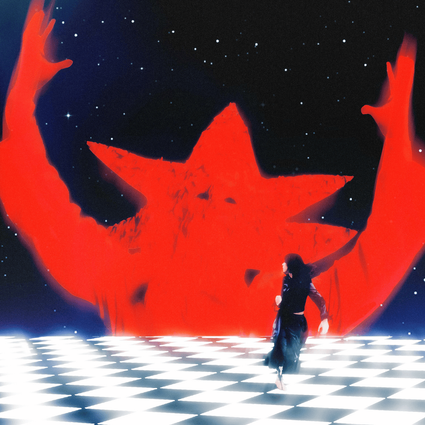
It is on “True Blue Interlude,” an in-universe ad for the Imaginal Disk procedure, that we first explicitly get a hint of the lore that envelops the record. As much as Magdalena Bay like to dabble in lyrics that offer a multitude of meanings based on the listener, they also offer an enigmatic story of their own throughout the album that revolves around the mysterious Imaginal Disk procedure, the foreboding presence of “The Doctor,” and the mysterious characters “True” and “Ghost.” The Doctor specifically is a person in all red robes with a giant star-shaped red headdress outfitted only with narrow slits for eyes. They appear on the single cover for “Image” as a massive being taking up the horizon while Mica runs away on a checkerboard floor. They are the one who performs the Imaginal Disk procedure, as showcased in the music videos for “Image” and “Death & Romance.” The procedure is not explained in any kind of thorough sense, but the core of the procedure is depicted on the cover of the album itself as an inhuman hand inserting a shining disk into Mica’s head. We see The Doctor insert a similar disk into her head in the music video for “Death & Romance.” It is also interesting to note that imaginal discs (with a c) are an actual thing in real life and are specifically a part of insect larvae that then evolves into a full grown body part during pupal transformation. A real-life physical self-evolution to compliment the mental self-evolution of Magdalena Bay’s fictional version.
Though the procedure itself is not explained in any detail, “True Blue Interlude” offers a dreamily convenient picture of the procedure that hearkens to the innumerable drug ads that have proliferated across American TVs for decades. There is a soothing beginning as the first moments of the song open with tranquil background voices almost whispering “(true blue, true blue)/ (true blue, true blue)” before the narration kicks in and the ad introduces the listener to their future improved self: “Say hello, it’s you, the purest you/ The next stage, the next phase is here.” We keep getting these repeated chime-ins of “true blue” throughout the track as the ad insists that you will still remain “you” after the “divine digits” insert the disk and “the nightmare lifts.” The overall effect of the song is both captivating and effective in giving an accurate sense of the source material it is pulling from; it is even complete with a portion in the middle with dramatically sped up lyrics akin to the obligatory drug commercial speed reading of possible side effects.
The run of these first three songs introduces core concepts of the album in terms of self-improvement and evolution and explores them in the realm of the fantastical as much as in that of reality: there is as much an exploration of inward discovery in a therapeutic sense as there is in a science fiction sense. The differing degrees each of these three tracks adheres to one of these realms is representative of the album as a whole since they occupy the extremes and middle of a spectrum. On one end, “True Blue Interlude” basically necessitates being read in a literal, outlandish manner since it is a straightforward ad for a fake procedure. Whereas on the other, “Killing Time” is much more of an open ended, pondering song about the dilemma of time’s inexorably constant death and all that it consumes in its destruction. Sure, “Killing Time” can also be thought of in terms of the specific story of Mica’s character and her consideration of undergoing the Imaginal Disk procedure, but its ambiguity and lack of explicit imagery ultimately make it an apt vehicle for a much greater range of potential meanings for the listener than “True Blue Interlude.” In the stylistic middle of these two songs sits “She Looked Like Me!” It includes more illustrative imagery than “Killing Time,” particularly Mica’s doppelganger attack, but it is also still opaque enough to be varyingly interpretable.
Along with the rich imagery on the album itself, Magdalena Bay also provide a bizarre companion website that offers some additional context to their lore. It consists of a map with clickable locations such as the “Installation Center,” “True’s House,” and “The Outskirts.” Each of these locations offers additional pathways, all that end at more strange imagery. Take, for instance, the weird clickable pillar complete with a glowing red orb that is labeled: “D-Ejected HQ.” When you click it, you get a close up of the same pillar on a grassy hill with impossibly quick clouds moving in the background. Clicking the pillar again leads to a dark room with two red doors on the left and right with glowing silhouettes dancing in the middle. This room is known as “main-dance-room” and clicking the door on the right leads to “bug-room” where a mantis smokes weed out of a bong. The same dancing figures and mantis are also in the music video for “That’s My Floor.”
The official lore of this album can be explored much more than the brief attention I gave it in this review, but I wanted to give just enough of a taste to show how rich it is. The great thing about this album is that all of that lore can also be completely disregarded for the purposes of your own interpretations and to stunning effect. I had my own ideas entirely when I first listened to Imaginal Disk and definitely was not imagining the nightmarish figure of “The Doctor.” Yet I found it a deeply moving record in my own way and one I was still readily able to infer my own emotional meanings from. Regardless of the context you have going in, Imaginal Disk offers a wealth of equivocal imagery beholden to no sole interpretation, which is clearly the intention of the band as seen in Mica’s ama reply. It is also one of the album’s greatest strengths since it makes the album a particularly intimate listen in multiple respects. As much as it can be understood through the lens of Mica’s personal journey of innermost discovery, Imaginal Disk simultaneously serves as an ideal backdrop for us to impart our own experiential ruminations on as it skillfully dabbles in a variety of themes without pigeonholing any of them. With that being said, I think overall the album can be pretty succinctly summed up by a specific video found on the companion website within “true’s-living-room” of a CD being spun on a vacuum motor until it explodes. Anyway, amazing album.
Favorite Song: Tunnel Vision
Leave a Reply