
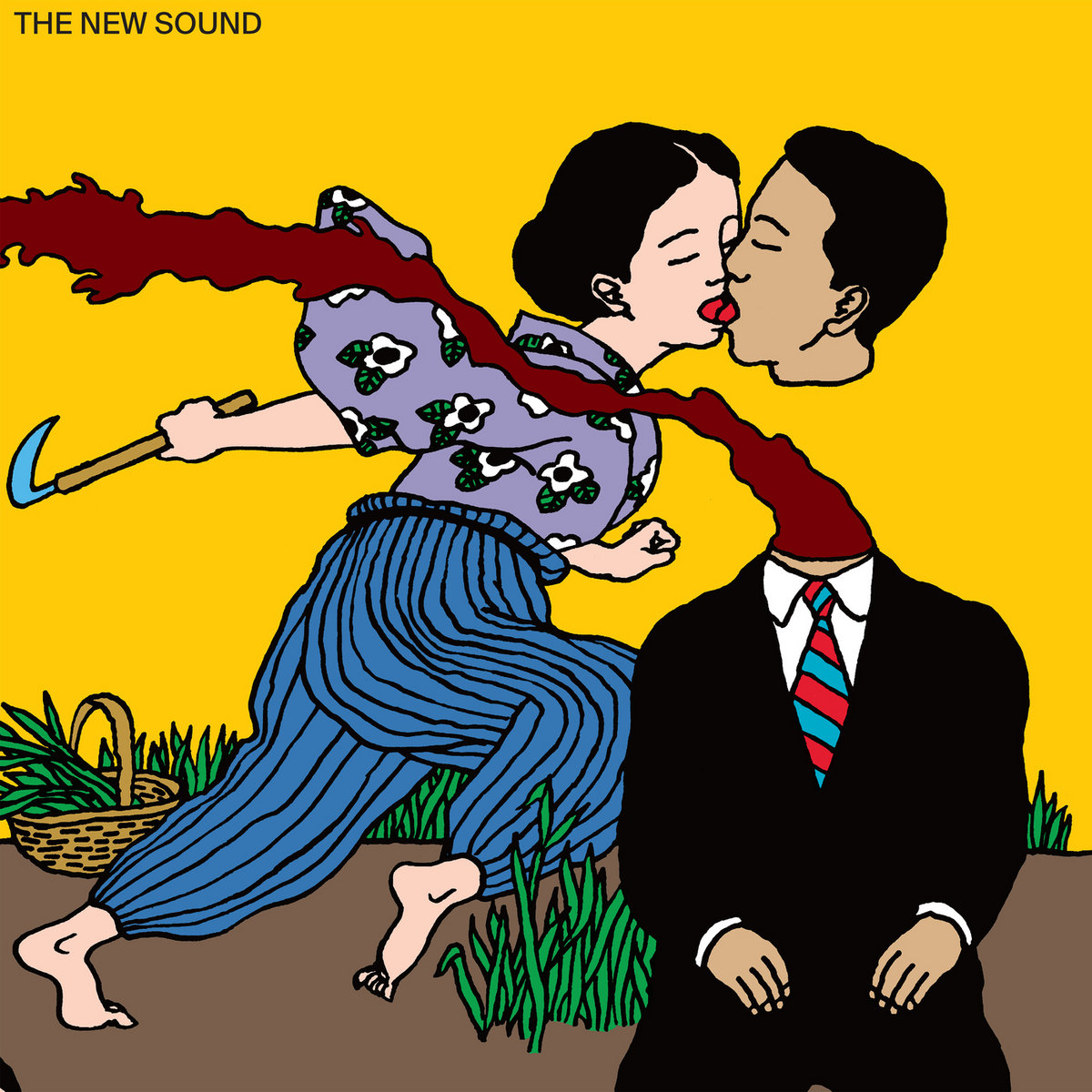
The New Sound
Geordie Greep
Let me begin by praising the ridiculous audacity of Mr. Greep. To name his debut solo project The New Sound, particularly after leaving black midi in such a messy fashion (announcing it drunk on IG live), was a risky move to say the least. I was immensely disappointed to see black midi fracture as they were (and remain) one of my all time favorite bands. Furthermore, I was expecting decades more of material from these guys, so their sudden rupture was quite sad. But then, shortly after surprise announcing their breakup (to the shock of the rest of the band as well as their fanbase), Geordie announced a new solo project in the works as well as a first single in “Holy, Holy.” And, you know, holy shit, it was really good. I was still fairly crestfallen, but I was also tentatively excited.
In the end, we got a record that ended up as one of my favorites of the year. The New Sound was exactly that, a completely new sound. Full of much more jammy jazzy goodness than the more chaotic, dark energy that characterized black midi’s material, Greep’s debut completely blew me away: though, not on first listen. Upon first listen, I was still missing the special sauce of black midi, and was reconciling with the fact that we would never see its return. Upon more and more spins, however, my appreciation for The New Sound only continued to exponentially grow. Despite the vast differences, I came to recognize, as well as really appreciate, the core similarity that did exist between The New Sound and my favorite black midi material: rich narrative imagery through vivid storytelling.
Take Hellfire, my favorite black midi record and my favorite record of 2022: I find this album most compelling because of the skill with which the band draws us into the bizarre, and generally fucked up, worlds they concocted. They achieved this through spectacularly layered instrumentation, visceral lyricism, and Greep’s signature vocal delivery. I had the great pleasure to see black midi live in 2022, and it was simply otherworldly the way they filled the room with a ghostly air that seemed to transport us to multiple other planes of existence.
Returning to The New Sound, we see a very similar emphasis on storytelling. There are still dazzling layers of complicated instrumentation, as well as lyricism that is just as rich. Of course, it is all brought together through the magnetic force of Greep’s vocals. However, they are completely different records as well. The two albums are both certainly theatrical in nature, but Hellfire is infused with a drama that is far more externally apocalyptic, so to speak. Contrastingly, The New Sound is also exceedingly dramatic, even in what I would describe as a similarly apocalyptic nature, but one that is inwardly focused. Instead of the hellacious imagery of Hellfire (on full display on songs such as “Dangerous Liaisons,” which is about the literal devil tricking a poor farmhand into committing a murder), The New Sound comes across as a skeevy, disgusting, and, most notably, melodramatic series of vignettes showcasing an inexorably decaying masculine bravado.
To dig into this further, there is an implied continuous narrative presence that is recurringly seen on the tracks “Holy, Holy,” “As if Waltz,” and “The Magician.” Specifically, of a deeply lustful man that destroys his marriage in his pursuit of a sex worker, as well as the tumultuous struggle he grapples with in the conflicting junction between his desire for an emotionally deeper relationship with said sex worker, and his profound shame at his self-destructive behavior.
Before this struggle comes into focus on “As if Waltz,” and “The Magician,” the narrator is first displayed in all of their self-imagined glory on “Holy, Holy.” On this track, Greep paints a picture of what ostensibly appears to be the archetypal macho womanizer:
I could tell you were lonely
From the moment you walked in
From the way you had your makeup on
From the way you’d done your hair
From the way you sat down next to me
From the way you ordered your drink
From the moment you put your hand on my knee
I knew I’d have you with ease
Do you come here often?
Do you know how this thing works?
Do you go to bed with a different man every night?
Don’t tell me I’m the first
Greep’s lurid descriptions of the narrator meeting a woman at a bar comes across as nigh satirical, particularly as the track transitions into a pre-chorus dripping with braggadocio:
You must have heard about me
Everyone knows my name
Everyone knows I’m holy
Yet, even here, we start to see the inevitable cracks in his masculine armor, what with the insistence that the woman at the bar surely must know him. It comes across as more desperate than strong: a distinction that seems increasingly accurate as the track progresses into the second verse:
You know my name?
Of course, you know my name
Everyone does, it’s true
It’s true, it’s true, it’s true
That I’m known around here
The barmaids know my name
I’ve had them all before
You are new, I’ll have you too
It’s time to give in
From the shores of Havana
To Moscow and Tokyo
In French Guianese, in Cantonese
Everyone knows my name
The facade is fully shattered by the time the track hits the bridge, my favorite part. It is then revealed that, rather than by chance, this encounter is instead occurring only due to the careful planning of the narrator, with assistance from a sex worker whom he hires to play the other role in his macho fantasy:
I’ll arrive at around 7 p.m.
And I want you to get there no later than 10
I want you to be dressed like a sophisticated tart
With too much makeup on, will that be alright?
And I want you to sit down next to me, as if by chance
I want it to seem like we’ve never met before
How much will that cost? I want you to look unsure of yourself
And I want you to look at me as if I’m attractive
I want your eyes to say, “Take me”
And I want your lips to be unimpressed
And I want you to ask the waiter if I really am who I say I am
And I want you to blush
I want you to shoot a smug look at the other girls
To make them jealous I chose you
When I tell you your pussy is holy
I want you to slap me and then kiss me
Make sure everybody’s watching, kiss me and then walk away
Walk to the bathroom, I’ll follow after
Don’t worry, we won’t do anything, we’ll just loiter there fifteen minutes or so
Then I’ll choose your new lipstick and we’ll walk back out
And I want you to tell me I’m a perfect dancer
And I want you to tell me I smell great
I want you to make me look taller
Could you kneel down the whole time? How much will that cost?
I want you to put your hand on my knee
Will that be alright?
I want you to look at me as if you’re lost
How much will that cost?
With the illusion broken, the song suddenly takes on a completely different meaning. This is not strong man, but one desperately trying to hold up the staggering weight of his own delusions. He has tied his masculinity inextricably to this elaborate character; consequently, he becomes more charlatan than man. One can only imagine how exhausting it is to maintain this pitiable front, which leads me to a throughline of the characters on this album: that no matter how repulsive they may come across, Greep intentionally presents them in all of their unvarnished patheticness with the goal of engendering some degree of sympathetic understanding in the listener. He says as much in an interview with Whiteboard Journal1:
“…I don’t think the song has to be relatable in terms of the actual situation or story of the song. But it should be relatable in the emotion of the song. That’s what I’ve tried to do here, where there is all this outlandish stuff going on, this kind of absurd, desperate, or funny situation going on, but the passion is palpable, and I’m actually feeling the emotion of the song. That’s relatable, I think. No matter how desperate or how disgusting these characters are in the songs, I hope at some point, people at least feel sorry for them or feel a similar feeling as them.”
Throughout The New Sound, Greep pulls his narrative inspiration from the tales told to him by men that he would meet drinking at various clubs. As farcical as this album comes across at times, there is an unnerving truth to the attitudes displayed within it. This is all the more the case in the wake of a continuing growth in the worst extremes of performative masculinity, especially those promoted by a growing subsection of exceptionally odious “influencers.” This problem is actually directly referenced on “Holy, Holy” in the chorus:
All the revolutionaries (Holy, holy)
All the Jihadis too (Holy, holy)
‘Round the world, I’m holy (Holy, holy)
Regarding the “Jihadis” line specifically, Greep explains the origin during an interview with Stereogum2:
These days there’s a lot of this stuff reaching extremes and becoming very scary in some ways. These guys are more isolated than ever. Go on to Twitter and everything is so extreme now. Maybe that’s a Boomer thing to say. But it’s true. In the last five or 10 years there’s a lot of change in this men stuff. People like Andrew Tate. Even on “Holy, Holy,” this line about the Jihadis — I saw a video of Andrew Tate saying, “Even ISIS watches my videos, even ISIS thinks I’m cool.” Like, he was bragging. And I was like, “What the fuck.” That’s the weirdest quote I’ve ever heard. That’s just one thing, but it’s stuff like all the time. These insane guys, and it’s real to somebody.
The opening track of The New Sound, “Blues,” opens the album with a preposterous presentation of the early stages of such toxic masculinity. Composed of increasingly silly lines, such as “And you have a bigger dick than any man who’s ever lived/ And you can cum more than a hundred stallions,” this song is a look at a possible origin of characters such as the narrator from “Holy, Holy.” During an interview with The Rolling Stones3, Greep comments on the track:
I wanted to do a song where it’s like, “Oh, look at this wanker — then again, we’re all kind of wankers”…We’ve all been 18. I wanted to do a song about when you think you’re the shit, and you have this feeling when you’re walking down the street, and you can imagine it’s a movie. Like, what a wanker! It’s just a load of funny lines strung together, really, with the theme of like 18-year-old pretentiousness.
The end result is an exceedingly silly, and fun, opening song. With an unforgettably fast-paced intro, it is one of the most catchy highlights of the tracklist. Yet, there is a darker element within as we come to see this mentality only lead to personal ruin; the more one builds their identity around pretending, the less they have an identity at all. There is a clear throughway from the 18 year old bravado of “Blues,” to the cataclysmic mid-life crisis of “Holy, Holy.”
Throughout the The New Sound, Greep weaves these elaborative storylines of downcast men in denial with beautifully colorful instrumentation and richly intricate song structures. The end result is a fascinatingly strange contrast in sonic “jammyness” and contextual perversion: of light-hearted grooves and heavy-weighted gloom. Above all else, it is an intensely theatrical journey that plumbs the depths of toxic masculinity. It is also great fun to sing along to – particularly “The Magician,” which features such banger lines as “And what of the endless, heedless, ennui?” Check it out.
Favorite Song: The Magician
Leave a Reply